Friday, January 20, 2012

Women like you: The Sigiriya rock paintings

"Ladies like you / Make men pour out their hearts. / You also have thrilled the body / Making its hair / Stiffen with desire.”

Sigiriya. Lion Rock. – There it sits in a corner of my memory, surprising, monumental, monstrous, enigmatic, its curvy garlanded women, those excited voices inscribed on stone, its lion’s claws and gaping lion’s mouth – all calling for my attention.

So here I return, now several months and a half a world away, to that rock and those women ….

Imagine a 150-metre high rock – a 50-storey building – rising suddenly and solitary from a vast green plain. The rock’s westerly face is covered in 500 frescoes of bare-breasted women, each festooned in flowers and jewels. On a nearby polished “mirror wall,” visitors are writing couplets and quatrains, graffiti-style, describing their responses on seeing the women. The remains of a palace rest on the summit, once accessible by walking from a terrace halfway up the rock through mammoth, stone-cut lion’s paws, then through the lion’s gaping mouth. Formal gardens, pools and fountains stretch from the rock’s base. In the far distance, earthen ramparts and a moat surround the whole complex.

Sigiriya – in north-central Sri Lanka, the buildings and gardens from the 5th century, the paintings from the same era or at least a century later, the graffiti added later still – is easily enough described in broad outline. But step beyond its most obvious characteristics and you enter a fog thicker than that swirling around Adam’s Peak in the mountains to the south.

Are these the ruins of a palace or a fortress – or both? Was the complex once a monastery or a king’s fortress refuge – or both? Was the king a patricidal megalomaniac or a pleasure-loving aesthete – or both?

And the women in the paintings (about 20 remain)?  They rise from painted clouds, full-breasted, shoulders soft and sloping, bodies splendidly adorned in flowery and bejewelled tiaras, coronets, bracelets and necklaces, their long delicate fingers holding lotus flowers and other blossoms, the line from coronet to hips suggesting that sensual S-curve of the female body found in sculpture, paintings and dance across south and east Asia.

Are these women a king’s courtesans? The work of court painters ordered to decorate the rock with beautiful maidens? Buddhist goddesses? Representations of the goddess Tara, or of Cloud and Lightning goddesses, or more lowly apsaras?

There are hardly two people who agree on any of this. Nor has the thin historical record helped, based as it is on chronicles, legends, hearsay and limited archaeological research, all of which has fed an array of speculative and conflicting claims.

On our visit, we arrived by foot amongst rows of parked vans and buses and hundreds of other visitors. The site attracts tens of thousands of visitors each year, mainly for the spectacular summit vistas and to see the women.

Our route takes us across the moat and ramparts, through the “pleasure gardens” with their formal patterns, fountains, and water hydraulic system (ingenious for the 5thC we read); along winding pathways at the foot of the rock, among boulder-strewn gardens, terraces, cisterns and pools, stone archways and a five-metre-long granite throne, all constructed from fallen boulders; then further up a modern iron staircase to the painting gallery and graffiti mirror wall; then higher still to the mid-level terrace, past the enormous sharp claws on the lion’s paws, past the ruins of the lion’s mouth, up and further up another iron staircase (the original steps were small carved hollows in the sheer wall) until we are at the ellipsis-shaped summit among the foundation ruins of tiered palaces and deep pools. Far beneath us spreads a dark green plain and glistening, meandering rivers, serpentine, serpents.

(A photograph of Sigiriya taken from the far west and at an elevation somewhat higher than the summit gives the rock and its westerly-flowing gardens the uncanny appearance of a colossal throne. Although the view seems one that would have been difficult for the builders of the 5thC palace-fortress to have experienced, other pre-modern peoples have imagined geographical shapes and relationships with surprising accuracy from an aerial perspective.)

It is here on the summit where we have our picnic lunch – or attempt to, if it weren’t for the monkeys that inch ever closer, lunges in their eyes, chattering every-monkey-for-itself chatter. It is only some barking hound from who knows where, 50 storeys up, who keeps them at a slight distance. A smart hound, this, for it is she who gets to gobble up our thank-you scraps and, inexplicably, is already waiting for us a thousand steps below at the lion’s claws.

But what about the star attractions of Sigiriya: the women in the frescoes?

Some people think that around the 10thC Sigiriya’s western face was covered in 500 similar images. Today only some 20 remain. The close-up view of the paintings used here would have been that of the painters, but it might not have been that of 10thC viewers. Some scholars argue that most people would have viewed the women from some distance, seeing them as representational figures in standard poses. This too is disputed.

The women’s upper bodies – they appear to emerge from cloud images at their hips and waists – are  naked except for their elaborate and colourful necklaces, bracelets, head ornaments and the flowers they hold. Each women is represented by certain common features (the S-curve of the body, the head’s downward tilt, the overall facial expression, the decorative/symbolic elements), and yet several also have subtly unique facial and bodily characteristics.

Most attractive for me are the women’s soft-sloping shoulders, the forward thrust of their pelvis and hips, the naturalistic folds of skin along the belly, the forward tilt of their necks and heads, their long arms and fingers, and the exquisitely gentle, loving, even sensual way those hands – long palms, curved fingers – hold lotus blossoms and other flowers. Looking at those fingers touching – caressing? – the blossoms, I feel such pleasurable tenderness. Surely we’re seeing here a centre of the painter’s personal felt-interest and energy.

The line of the women’s arms, wrists, palms and fingers suggest the sensual S-curves formed by the line through each woman’s tiara, head, neck, chest, waist and hips. This same bodily S-curve or tribhanga pose, emphasizing hips and breasts, is found in ancient representations of women across Hindu and often Buddhist -influenced Asia.

Curiously, most of the women’s breasts seem attached to (not a natural element of) their bodies. It is as the painters had sculptural models in mind, not live models, or in depicting life-giving goddesses, they were treating breasts as a symbol of fertility and sustenance. The breasts are also exaggerated relative to the overall body size, and they exaggerate in turn the slightness of the women’s waists with their natural rolls of flesh. A partial exception is a woman painted in profile whose breasts have natural weight and downward pull. We won’t know if there were other women like this, more naturalistic, among the five-hundred.

The women’s eyes are sometimes bright and outward-looking, but more often slightly downward cast, languid, and always noticeably long. Their lips are often curved into indecipherable – content, waiting, patient, whimsical, comforting? – smiles. One modern-day viewer describes the ‘look’ as both open and introvert at the same time, and I can see why. There’s something of I-am-ready-to-be-whatever-you-expect in that look.

I was told by a guide at the gallery that each figure represented a woman from Sri Lanka and other parts of the world: Africa, the far east, Persia. Although it is not a claim I have found anywhere else, it is true that at least one woman has distinctly African facial features.

(Having said all this, I read that centuries of wear on the paint and elements of the painters’ techniques can result in distortions in visual detail and thus in modern-day responses, especially regarding the women’s faces.)

Why were these paintings done in the first place? And what really existed at Sigiriya in ancient times? Contending theories, most of them strongly speculative, abound.

One approach sees the 5thC palace-fortress complex as the brainchild of King Kassapa and his court. According to the Mahavamsa chronicle, written years after the events it describes and sketchy at best, Kassapa entombed his father-king alive then, fearing retribution by his brother, fled to Sigiriya where he build a fortress-palace. (Kassapa’s brother eventually killed him, or he killed himself, depending on how you read the page leaves.)

Kassapa himself has been given many identities. In one version he is not a patricide at all, but rather a misunderstood or misremembered aesthete, the pleasure palace, gardens and paintings his secular “homage to beauty.” In another he is a devout leader, a patron of the local monastery, who had the paintings done for religious purposes (or: to glorify his own image). Or he built the complex to honour his father. Or he is a king-murdering, narcissistic, paranoid megalomaniac (remember the lion’s claws and mouth?) who led repeated wars against his neighbours and indulged in profligate ‘beautification’ projects.

Quite another approach is to see Sigiriya as a Buddhist monastery. Indeed its rock shelters and caves functioned like this before Kassapa’s time and the site became a monastery again a century (or five centuries) later. In this view, the paintings are done after Kassapa’s tenancy, the women represent various religious figures and the rock becomes a place of pilgrimage.

So who are these women? Courtesans of the royal court and bed chambers? Queens and princesses on their way to worship Buddhist gods? Beautiful, decorative objects, like the gardens and fountains? Heavenly beings (those clouds) of various kinds: your standard apsaras waiting on the gods; Lighting and Cloud goddesses, created to glorify Kassapa; the Mahayana Buddhist goddess Tara, a favoured goddess found across south and east Asia, a splendidly-adorned female Buddha associated with compassion, enlightenment, power and prosperity? 

Welcome to the fog of understanding hanging over Sigiriya.

For most of us, though, maybe it needn’t matter what the women are supposed to represent; maybe what matters is how we experience them in themselves. This is the approach taken by the graffiti writers – some 1,500 of them: kings and queens, monks, a guard, a smithy and other travellers – who began visiting the paintings a century and more after they were completed. Their comments are of great interest to those studying the Sinhalese language and script, but they also give us a good sense of what people of the time understood these paintings to be about in terms of their own experience.

On one essential point – and in stark contrast to a major line of modern-day theorizing on the paintings – many of the graffitists agree. Whereas the visitors appear to have arrived with an understanding that the goddess-women are supposed to elevate them into a ‘heavenly’ state of physical disinterestedness, detachment, contemplation and piety, unencumbered by physical desire, their own experience of the women has the exact opposite effect.

As one person writes: “Ladies like you / Make men pour out their hearts / And you also have thrilled the body / Making its hair / Stiffen with desire.”

And a second: “By means of the splendour of the mountain side, I saw their manner in which nymphs stood in heaven. My hand jumped up with the desire of grasping their girdle in dalliance.”

Or: “The girl with golden skin entices the mind and eyes. / Her lovely breasts cause me to recall swans drunk with nectar.”

 And: “Who is not happy when he sees / Those rosy palms, rounded shoulders / Gold necklaces, copper-hued lips / And long long eyes.”

A woman, too, sees attractive rivals in the paintings: “A deer-eyed young woman of the mountainside arouses anger in my mind. In her hand she holds a string of pearls and in her looks she assumes rivalry with me.”

The heavens don’t stand a chance, as at least one visitor makes clear,: “The ladies who wear golden chains on their breasts beckon me. As I have seen the resplendent ladies, heaven appears to me as not so good.”

The women as objects of contemplation, detachment, piety – as some scholars argue? Hardly. These are embodied, sexual responses, the responses of longing, attraction and expectant fantasy. Whatever the painters’ patrons thought they were asking to be depicted on Sigiriya’s walls, what they got “thrilled the body” and made heaven “not so good.”

Today, writing on Sigiriya’s walls is forbidden, which is too bad because surely visitors still have things they’d like to say, and some arrangement could be made for the old wall’s protection.

But there it is: keep your experiences to yourself.

No everyone is so compliant though. Here is Canadian writer Michael Ondaatje’s Sigiriya poem “Women Like You.” 

Women Like You
(the communal poem – Sigiri graffiti, 5th century)
They do not stir
these ladies of the mountain
do not give us
the twitch of eyelids.

            The king is dead.

They answer no one
take the hard
rock as lover
Women like you
make men pour out their hearts

            ‘Seeing you I want
            no other life’

            ‘The golden skins have
            caught my mind’

who came here
out of the bleached land
climbed this fortress
to adore this rock
and with the solitude of the air
behind them
            carved an alphabet
whose motive was perfect desire

wanting these portraits of women
to speak
to caress.

Hundreds of small verses
by different hands
became one
habit of the unrequited.

Seeing you
I want no other life
and turn around
to the sky
and everywhere below
jungle, waves of heat
secular love
Holding the new flowers
a circle of
first finger and thumb
which is a window
to your breast
pleasure of the skin
earring     earring
curl
of the belly
         and then
stone mermaid
stone heart
dry as a flower
on rock
you long eyed women
the golden
drunk swan of breasts
lips
the long long eyes
we stand against the sky
I bring you
a flute
from the throat
of a loon
so talk to me
of a used heart

This equitorial greenland: first impressions of Sri Lanka


Arriving in Sri Lanka after several months in India, we are especially struck by the absence of throngs of people, so much less traffic, deeply breathable air, 
spaces to stroll, the relative quiet, the relaxed expressive manner of people, what seems like so little garbage littering the roadsides. All in all it feels like a more humanly manageable, calmer, even happier world.


 This is a green world vibrant wet rice paddy greens, hillsides of laurel-leaf tea greens (the newest leaves lime-toned, deep forest greens beneath), the greens of coconut and banana palms, pine, mahogany, teak, satinwood, ironwood and ebony tree greens, dusty eucalyptus greens, fig tree greens, bamboo grove greens, spice plant greens: cinnamon trees, cardamom, nutmeg, pepper. Sun glistening greens, shower mist greens. Vine and creeper greens in leafy loops up, down and around and up again. And not just a green world but one abundant with flowers: pinks, reds, oranges, yellows. Acacias, flamboyants, bougainvilleas, hibiscus, fantastically large-deep-throated creamy tulip blossoms.

This, at least in the central and southerly regions, is also the Buddha’s world. Buddhas sitting white and monumental on hilltops, their sleepy eyes staring across towns and countryside.  Buddhas in glass roadside shrines. Buddhas sitting on bus dashboards and featured in glittery images hanging from bus windshields and shop walls. (Buddhism has often had an angry face in Sri Lanka, taking a turn into nationalism and violence for many decades. Influential groups within the Buddhist hierarchy, eagerly supported by monks and nuns, have often led the call for a more Buddhist, a purer Sri Lanka, and have repeatedly attacked those calling for tolerance and diversity, a genuinely multi-ethnic, multi-belief country.)

After India … As we walk along roads and pathways we are greeted with a genuine-feeling “Good morning” or “Hello” and natural smiles unconditionally offered – all so rarely experienced in India.  These easy smiles make us aware how, in memory, fewer people in India seem to smile, how eyes stay focused on the crowded way ahead, the anonymity of so many moving bodies.

Even the bus ticket collectors and drivers here seem characteristically helpful. People at stations seem to know their buses and trains and offer mostly reliable information. Crowded buses and trains there are, but the atmosphere seems more congenial, as if people know that further down the line, or on the next journey, things will be easier.

Most things here feel as if they are functioning at a relatively smaller, less complicated scale. We have mostly been in modest sized cities or small towns, each one of which would be so much larger and teeming in India, along with more vehicles, more exhaust, more noise. In Dambulla, Kandy and other Sri Lankan towns there are uncluttered sidewalks. The streets have painted cross-walks at which drivers actually stop and enable pedestrians to cross in safety. I don’t remember seeing any of this in India.  In Kandy a grated barrier separates main streets and sidewalk, thus preventing the usual Indian clutter of motorbikes, cars, tuk-tuks, bicycles, shop merchandise and dropped garbage that make walking so frustrating and tiring.

Some things, though, haven’t changed between countries – like the rupee-squeezing auto-rickshaw drivers and the aggravation of never arriving at anything like a fair fare without a struggle. One well-meaning guesthouse host tells us that she and others also have to endure this annoyance, but we quickly learn that sharing the pain doesn’t help either. 
 
Somewhere like this … I look around – out bus windows, down streets, into yards – and find myself thinking I might be in St. Vincent or St Lucia. Why? Perhaps it is the flouncy, layered, brightly-patterned, embroidered skirts worn by the women, or their blouses with sleeves puffed and frilly at the shoulders, the un-Indian clash of pattern and colour, the many-coloured umbrellas protecting against the searing midday sun. Perhaps it is the small cottages washed in pastels, tucked among banana trees, with their red tiled or corrugated metal roofs, laundry drying on bushes and rocks, a pack of dogs (the ones that yapped all night) on the prowl or sleeping in the shade. Something in the physical features of people? The number of people pedaling ancient bicycles? A quality of the voices and speech: softer, a little slower, much gentler than where we have been? I don’t know … but the association keeps returning as if somehow existing out there.


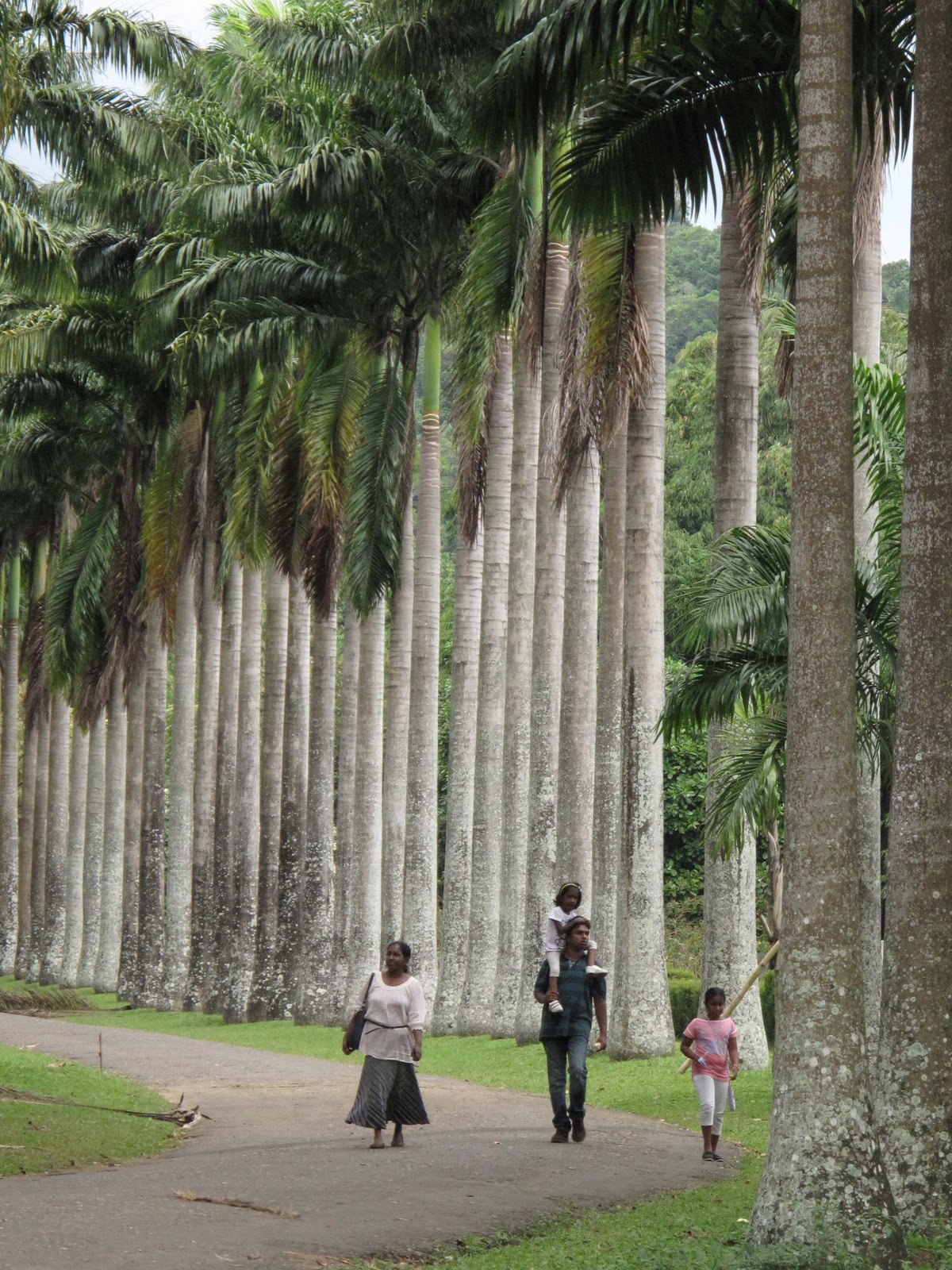
Greenland again … A walk amongst lovers and families through the calming Royal Botanical Gardens outside Kandy. Memories of its bamboo groves, a collection of fantastically coloured and shaped orchids, undeniably a female flower, gangly fig trees, palms twisted, soaring and paunchy. Young lovers, of which there were many, cuddle in shady half-hideaways, chatting, planning, dreaming, enjoying this leafy refuge from family and friends. A father in casual slacks and cool short-sleeved shirt takes photos of his sons and their mother, the latter an upright black presence covered head to feet in black burqa, fingers appearing and vanishing, pupils, irises and scleras flitting along a narrow slit in the fabric, sparkles hinting at jewelled sandals and anklets.

Another day: the train from Kandy to Haputale, a six-hour ride, rising into dense misty rain forests. Tree giants, more crowded than the people in Paharganj’s Main Bazaar,   soar skyward as if in desperation. The upper canopy sprouts dark branches, like the bare ribs of an upturned, wind-shattered umbrella. The train now winds round hill after hill, some soft-sloping, some jagged and precipitous but all covered in tea plants. Lanes curl along the plantation slopes like great inch-worms. The trunks and crowns of the plantations’ lanky shade trees hover in the ebbing, flowing mist, seeming to play cat-and-mouse with the prowling rocky crags beneath.

In the afternoon we climb Little Adam’s Peak, a series of four sharply rising peaks, their summits just below the cloud line. South through Ella’s Gap sits the Sri Lankan lowlands and the hazy beyond. The warm sea, then Antarctica, are out there somewhere. To the west Ella’s Rock – our destination tomorrow – disappears into the clouds. (See the posting on “Mr Gindasa.”) A tall bearded man, standing for a surprisingly long time in the yoga tree posture on the summit’s summit, describes to a companion how “there must be a market for a spa, you know a really authentic place, a true healing place in these hills.” Immediately beneath us, the tea plantings tumble downwards through the glow and shadows of broken clouds until they dissolve into a plain of rice paddy greens and sky-blue lakes.

Travellers to Sri Lanka will sooner or later come upon the story of how, more than one-hundred years ago, in the 1890s, Thomas Lipton – another of those many restless Scots, “son of poor Irish immigrants, a childhood amidst the slums of Glasgow,” “hugely successful entrepreneur,” the biographers write – stood on these same hills and imagined a land covered with tea, his tea. With next to cost-free land and indentured labour (today’s official Lipton Tea site refers to “5,000 hands”), he planned to bypass the traditional trade and marketing channels of the tea business and sell directly, and cheaply, to the untapped working class market. “Direct from the tea garden to the tea pot,” was his brightly-packaged teabag catch-phrase. 

It is now said, in that verbal short-hand so often taken as reliable history, that “Lipton” created this landscape. And what of those “5,000 hands,” originally and still mostly Tamils, still among the poorest of the poor in Sri Lanka, living in “lines” of small houses, the women with little privacy and at risk of sexual harassment, many girls working the plantations by adolescence? Looking across these hills, I – the retired, labourless traveller – see this place as theirs, a land that they have made … in all its green-hued beauty, its absolute stillness, its swift movement, its enchantment.


Road-stained: further reflections on traveling in India


Waiting for the plane from Chennai to Colombo, Sri Lanka, at the end of our 14 week journey in India. My thoughts full of memories. Conversations, voices, faces.

A father obsessed by his plans to see his daughter married “well,” the daughter wavering between resignation and disinterest. A brother’s murder in 2002 politically-incited attacks in Gujurat of Hindus against Muslim. A young woman’s story of fleeing Chinese-occupied Tibet.

The colours and sounds and touch of place. A sacred tree in a village high over Naggar town. That boisterous meeting of the gods in Kullu. Two women walking along a glacial river’s edge, backs bent under loads of green winter silage larger than their own bodies. A child playfully decorating and undecorating a Ganesh sculpture twice his size.

That new India bus station we landed in – Shimla, I believe: industrial, cavernous, barren, dark, seatless, surely the work of some “notable personality” (the media’s jargon) adept at turning mountains of sand and cement into Porsches and a “prestigious farmhouse property” in Chattapur.

A stone Jain temple floor in Jaisalmer, worn buttery smooth, so pleasingly cool on the bare feet, curvy heavy-hipped nymphs carved in warm golden sandstone dancing in the votive lights.

The relief of quiet walks in mountain forests, in the desert, in bird-filled wetlands.
                                                                                       
Quiet. Relief. Then something like a tsunami wave of another “India” rolls over in, as it has before, like an obsession. That incessantly noisy India, so overwhelmingly congested. The constant dodging of buses, trucks, tuk-tuks, bicycles, cows, cars. Our throats burning with exhaust and dust. Those walks through waste and filth, past warm walls reeking with men’s urine …. 

Worse of all, in retrospect, is how this assault of the surround, a sensory assault, biting at our nerves, had the effect of reducing the circle of our attention onto the next physical step, the body jerking away from yet another threatening honk over one’s shoulder. The sensorium living in a state of emergency.

Still – there were other times on some days when I felt the attractiveness of that same surround: the grand unfamiliar hubbub; the crazed mingling of slow-motion cattle amidst the frenetic jostling of vehicles, pedestrians and shop-keepers; the grandiosities of shop names and their curious self-descriptions in English; the fantastical world of temple iconography and worshippers; people so naturally refined, seeming to move as if oblivious to the surrounding mayhem and filth.

But even these pleasures so often succumbed to weariness, irritability, a yearning for peace and quiet. Only in the villages and country paths and places of quiet like the Gandhi ashram in Ahmedabad could I begin to look, hear, smell more in my own way, have a thought and follow it, arrive at a small shrine at the base of a great tree, then stop, linger, wonder.

My second India traveling companion, V.S. Naipaul’s “India: a Million Mutinies Now,”  describes the stress of getting around, in this case Bangalore in the late 1980s. “We had to walk carefully, picking our way over broken or unmade footpaths. Level or fully made footpaths are not a general Indian need, and the Indian city road is often like a weaving, bumpy, much mended asphalt path between drifts of dust and dirt and the things that get dumped on Indian city roads and then stay there, things like sand, gravel, wet rubbish, dry rubbish; nothing ever looking finished, no kerbstone, no wall, everything in a half-and-half way, half-way to being or ceasing to be. / Deviah would have liked to talk while we walked, but it was hard. We were being kippered all the time by the gritty smoke from cars and scooters …. By the time we reached the minister’s house we had become part of the Bangalore road scene, with dust and fumy grit on the skin and clothes and shoes and hair and glasses … we had become road-stained.”

Is this feeling “road-stained” the experience of the majority of Indians? I often wondered about this, but still have no idea. Many seem to move with a noticeable sense of determined purpose, here to there, not much lingering. And many move with an adeptness that can only astonish the stranger. When asked, some seemed to dismiss or deny the chaos, but questionably because of their glancing references to national pride. Others – those frozen faces, those rare frowns, those hints of a forced-seeming smile on bus passengers as we careen terrifyingly down crowded, narrow highways or alongside cliff edges: what is one to make of those faces? Resignation? Bravado? Karmatic foresight?

And I still wonder how alive, sensing Indians somehow slip through the ear-splitting, seemingly impenetrable densities of public space that so quickly made me so tense. There they are, chatting on cellphones, yelling across the throngs, making purchases and deals, catching up with a passing acquaintance, hoot hooting without end, inching their ways through the relentless pandemonium, apparently not unnerved, not frantic.

Curious and always astonishing to me how they do somehow appear to slip through the frenzy, like they slip ever so closely past one another in crowds and, as drivers, slip a hair breath’s past oncoming vehicles or along the rim of a mountain road.
                                
That capacity to slip through the crowds? Does it have an auditory and olfactory equivalent for Indians? Do they possess an additional capacity to somehow slip through the din, filth and stench? Sometimes I might believe this, but then I have seen Indians cover their faces with scarves, handkerchiefs, rags and saris against the dust and exhaust. I have seen them grimace at the shrieking horns. Surely they must also feel this environmental chaos attacking them, discomforting them. Some Indians living in towns and villages seem to confirm this: “So noisy and crowded in Delhi.” “I’d never live in Ahmedabad; too many people, terrible air.” “Ah old Varanasi! Impossible!”

An Indian acquaintance describes to Naipaul the difficulty of doing the simplest thing in India, the difficulty of arranging the physical details of day-to-day living. There are no rules on the Indian streets, he says. “You feel a bit like being in a jungle, and this can transfer to a large view of things. It can, and does …. A lot of energy goes into these things, those traffic jams, that chaos.”

And what about that apparently widespread northern and urban Indian habit (there are always so many exceptions to a statement like this, possibly millions of exceptions in India!) of talking over the din, so loudly, with such seeming force, assertion, as if one might never be heard otherwise?  Is it an acknowledgement that the usual conversational human voice, the voice one might use in an uncrowded village or town or in the pre-industrialized world, just doesn’t work in most of India?

“This can transfer to a large view of things,” says Naipaul’s correspondent. Caught helpless in sweaty gridlock in some exhaust-filled city, I have also found myself wondering whether the daily experience of this “jungle” is some of the kindling that fuels India’s recurrent episodes of horrific violence, pitting neighbour against neighbour, so quickly moving otherwise ‘ordinary’ people to barbarism?

India leaves me wondering whether the day-to-day life of so many Indians – the effort of basic necessary movement, the effort to gain necessities, of living with filth and frenzy, of living amidst corruption and abuses from bottom to top, of living “road stained” – fund a kind of felt vulnerability and humiliation and resentment, and possibly, too, some desperately driven aspiration to ‘move up’ or ‘move out’. And whether these funds of aggravation and restlessness, borne with such apparent resignation, are like dry kindling, sitting there unremarkable until the next despot appears, sparks flying off his talk of “enemies” and honour and shame … or transmuted into the eager, impatient voices and eyes of the many engineering, software and business students one meets?

(NOTE: On the ‘dry kindling’, see Ward Berenschot’s Riot Politics: India’s Communal Violence and the Everyday Mediation of the State. Also: Pankaj Mishra, “The Gujarat massacre: New India’s blood rite.”)

Are there also qualities in Hinduism that give people a capacity to find some liveable accommodation with the frenzy that is urban India? Maybe. But then I think of the life of so many of the temples we visited where brief moments of quiet reverence collide against the surrounding pandemonium: bells, gongs, shouting, chanting, bouncy cellphone ringtones, loud voices on cellphones, rushing throngs of pilgrims, scurrying merrily between shrines like they are in some fairground.

In contrast to this, our friends Santosh and Prem have created a place of peace around their home shrine. Perhaps many other Indians do as well; many homes and yards we visited include small shrines at which quiet, meditative prayers and rituals can take place.

But many of the domestic or family or home spaces we experienced, spaces often set just off from guesthouse spaces, did not resemble the overall symmetries and spaciousness – respite from the bedlam outside – of the home of our friends Santosh and Prem. Far from it.

Instead, these domestic spaces, to which so many Indians arrive each day, seemed to mimic the crowded chaos they had just left: small rooms packed with furnishings often covered in scatterings of clothes and papers; family photos and mementos the only objects given some settled pride of place; each room a thruway for everyone; a TV on somewhere; the constant cellphone jingles. And all this is not consider the poor 
quarters so many Indians call home.   

Respite from the bedlam, aspirations and longings labouring amidst a maze of obstacles. Does this partly account for the abundance of gurus, priests, shamans, fortune-tellers, astrologers and palm, card, rice and sand grain readers doing a pretty good business across the India?

Indians can answer whether or not the gurus deliver. I came to see them functioning more like the garlands of plastic flowers, flashing  images of gods and goddesses, the stuffed lions and tigers, the crosses and miniature stupas, strings of beads, swaying fringes, bells and smoking incense seen covering bus and lorry dashboards and windscreens – a clutter intended to ward off disaster but in reality increasing its likelihood.


Tuesday, December 27, 2011

Christmas Day 2011: Mamallapuram, Bay of Bengal, Tamil Nadu


We begin the day with gifts – the promise of mutual ayurvedic massages, a chocolate bar each, I re-open the dhoti fabric Betty bought me several weeks and one peninsula ago – then a walk out to the shoreline, among fishermen picking the night’s catch from nets, women gathering the specimens they want for market stalls, young waifs in rags selling necklaces, the odd cow dozing between boats.

After breakfast we join the Sunday throngs down from Chennai to visit the nearby temples and beaches. The atmosphere on the beach is festive: carnival games and rides, fresh slices of watermelon and pineapple on offer, whoops and high-pitched screams as children jump into the surf, caution on the faces of adults in full dress, stepping tentatively into the shallows. 


It’s the same picture at the remarkably complete stone-cut ruins of what was once the great port city of the 4th to 9th century Pallava dynasty. Apparently an 8th century Tamil text describes this place as Kadal Mallai, Sea Mountain “where the ships rode at anchor bent to the point of breaking laden as they were with wealth, big trunked elephants and gems of nine varieties in heaps.” Today, holidaying children and adults clamber over and around splendidly-detailed bas-reliefs, rock-cut temples, chariots, and life-sized free-standing granite lions and elephants, each figure and scene sourced in stories from the Hindu epic The Mahabharata. Is there anywhere on earth where ancient places are such crowded playgrounds, picnic sites and backdrops for countless glamour photos?


Returning to town, we pass the clink-clink-clink hammer blows of stone carvers bringing to life bookshelf and garden size Shivas, Nandis, polished lingas, Durgas, Vishnu, lions, buxom apsaras and Ganeshes, including tiny ones stretched out in front of Apple computers.

Day’s end and a Christmas dinner of prawns, rice, a coconut veggie curry, beer and ice cream sundaes, served under the night sky, sea surf shuffling in the distance, starry yellow lights spiralling up a nearby palm, tuk-tuks putt-putt-puttering along the street below. Merry Christmas Mamallapuram.