Friday, January 20, 2012

This equitorial greenland: first impressions of Sri Lanka


Arriving in Sri Lanka after several months in India, we are especially struck by the absence of throngs of people, so much less traffic, deeply breathable air, 
spaces to stroll, the relative quiet, the relaxed expressive manner of people, what seems like so little garbage littering the roadsides. All in all it feels like a more humanly manageable, calmer, even happier world.


 This is a green world vibrant wet rice paddy greens, hillsides of laurel-leaf tea greens (the newest leaves lime-toned, deep forest greens beneath), the greens of coconut and banana palms, pine, mahogany, teak, satinwood, ironwood and ebony tree greens, dusty eucalyptus greens, fig tree greens, bamboo grove greens, spice plant greens: cinnamon trees, cardamom, nutmeg, pepper. Sun glistening greens, shower mist greens. Vine and creeper greens in leafy loops up, down and around and up again. And not just a green world but one abundant with flowers: pinks, reds, oranges, yellows. Acacias, flamboyants, bougainvilleas, hibiscus, fantastically large-deep-throated creamy tulip blossoms.

This, at least in the central and southerly regions, is also the Buddha’s world. Buddhas sitting white and monumental on hilltops, their sleepy eyes staring across towns and countryside.  Buddhas in glass roadside shrines. Buddhas sitting on bus dashboards and featured in glittery images hanging from bus windshields and shop walls. (Buddhism has often had an angry face in Sri Lanka, taking a turn into nationalism and violence for many decades. Influential groups within the Buddhist hierarchy, eagerly supported by monks and nuns, have often led the call for a more Buddhist, a purer Sri Lanka, and have repeatedly attacked those calling for tolerance and diversity, a genuinely multi-ethnic, multi-belief country.)

After India … As we walk along roads and pathways we are greeted with a genuine-feeling “Good morning” or “Hello” and natural smiles unconditionally offered – all so rarely experienced in India.  These easy smiles make us aware how, in memory, fewer people in India seem to smile, how eyes stay focused on the crowded way ahead, the anonymity of so many moving bodies.

Even the bus ticket collectors and drivers here seem characteristically helpful. People at stations seem to know their buses and trains and offer mostly reliable information. Crowded buses and trains there are, but the atmosphere seems more congenial, as if people know that further down the line, or on the next journey, things will be easier.

Most things here feel as if they are functioning at a relatively smaller, less complicated scale. We have mostly been in modest sized cities or small towns, each one of which would be so much larger and teeming in India, along with more vehicles, more exhaust, more noise. In Dambulla, Kandy and other Sri Lankan towns there are uncluttered sidewalks. The streets have painted cross-walks at which drivers actually stop and enable pedestrians to cross in safety. I don’t remember seeing any of this in India.  In Kandy a grated barrier separates main streets and sidewalk, thus preventing the usual Indian clutter of motorbikes, cars, tuk-tuks, bicycles, shop merchandise and dropped garbage that make walking so frustrating and tiring.

Some things, though, haven’t changed between countries – like the rupee-squeezing auto-rickshaw drivers and the aggravation of never arriving at anything like a fair fare without a struggle. One well-meaning guesthouse host tells us that she and others also have to endure this annoyance, but we quickly learn that sharing the pain doesn’t help either. 
 
Somewhere like this … I look around – out bus windows, down streets, into yards – and find myself thinking I might be in St. Vincent or St Lucia. Why? Perhaps it is the flouncy, layered, brightly-patterned, embroidered skirts worn by the women, or their blouses with sleeves puffed and frilly at the shoulders, the un-Indian clash of pattern and colour, the many-coloured umbrellas protecting against the searing midday sun. Perhaps it is the small cottages washed in pastels, tucked among banana trees, with their red tiled or corrugated metal roofs, laundry drying on bushes and rocks, a pack of dogs (the ones that yapped all night) on the prowl or sleeping in the shade. Something in the physical features of people? The number of people pedaling ancient bicycles? A quality of the voices and speech: softer, a little slower, much gentler than where we have been? I don’t know … but the association keeps returning as if somehow existing out there.
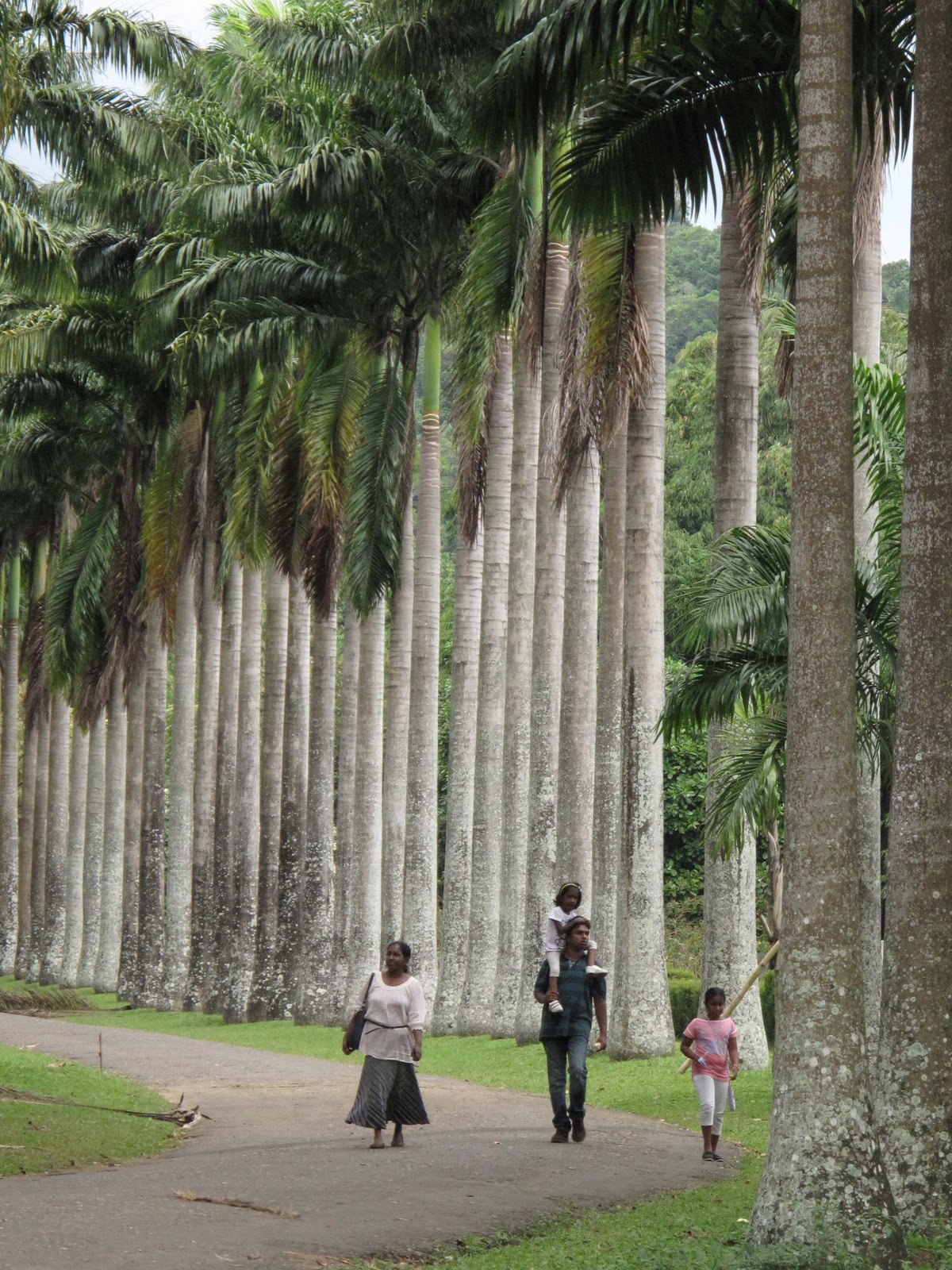

Greenland again … A walk amongst lovers and families through the calming Royal Botanical Gardens outside Kandy. Memories of its bamboo groves, a collection of fantastically coloured and shaped orchids, undeniably a female flower, gangly fig trees, palms twisted, soaring and paunchy. Young lovers, of which there were many, cuddle in shady half-hideaways, chatting, planning, dreaming, enjoying this leafy refuge from family and friends. A father in casual slacks and cool short-sleeved shirt takes photos of his sons and their mother, the latter an upright black presence covered head to feet in black burqa, fingers appearing and vanishing, pupils, irises and scleras flitting along a narrow slit in the fabric, sparkles hinting at jewelled sandals and anklets.

Another day: the train from Kandy to Haputale, a six-hour ride, rising into dense misty rain forests. Tree giants, more crowded than the people in Paharganj’s Main Bazaar,   soar skyward as if in desperation. The upper canopy sprouts dark branches, like the bare ribs of an upturned, wind-shattered umbrella. The train now winds round hill after hill, some soft-sloping, some jagged and precipitous but all covered in tea plants. Lanes curl along the plantation slopes like great inch-worms. The trunks and crowns of the plantations’ lanky shade trees hover in the ebbing, flowing mist, seeming to play cat-and-mouse with the prowling rocky crags beneath.

In the afternoon we climb Little Adam’s Peak, a series of four sharply rising peaks, their summits just below the cloud line. South through Ella’s Gap sits the Sri Lankan lowlands and the hazy beyond. The warm sea, then Antarctica, are out there somewhere. To the west Ella’s Rock – our destination tomorrow – disappears into the clouds. (See the posting on “Mr Gindasa.”) A tall bearded man, standing for a surprisingly long time in the yoga tree posture on the summit’s summit, describes to a companion how “there must be a market for a spa, you know a really authentic place, a true healing place in these hills.” Immediately beneath us, the tea plantings tumble downwards through the glow and shadows of broken clouds until they dissolve into a plain of rice paddy greens and sky-blue lakes.

Travellers to Sri Lanka will sooner or later come upon the story of how, more than one-hundred years ago, in the 1890s, Thomas Lipton – another of those many restless Scots, “son of poor Irish immigrants, a childhood amidst the slums of Glasgow,” “hugely successful entrepreneur,” the biographers write – stood on these same hills and imagined a land covered with tea, his tea. With next to cost-free land and indentured labour (today’s official Lipton Tea site refers to “5,000 hands”), he planned to bypass the traditional trade and marketing channels of the tea business and sell directly, and cheaply, to the untapped working class market. “Direct from the tea garden to the tea pot,” was his brightly-packaged teabag catch-phrase. 

It is now said, in that verbal short-hand so often taken as reliable history, that “Lipton” created this landscape. And what of those “5,000 hands,” originally and still mostly Tamils, still among the poorest of the poor in Sri Lanka, living in “lines” of small houses, the women with little privacy and at risk of sexual harassment, many girls working the plantations by adolescence? Looking across these hills, I – the retired, labourless traveller – see this place as theirs, a land that they have made … in all its green-hued beauty, its absolute stillness, its swift movement, its enchantment.


Road-stained: further reflections on traveling in India


Waiting for the plane from Chennai to Colombo, Sri Lanka, at the end of our 14 week journey in India. My thoughts full of memories. Conversations, voices, faces.

A father obsessed by his plans to see his daughter married “well,” the daughter wavering between resignation and disinterest. A brother’s murder in 2002 politically-incited attacks in Gujurat of Hindus against Muslim. A young woman’s story of fleeing Chinese-occupied Tibet.

The colours and sounds and touch of place. A sacred tree in a village high over Naggar town. That boisterous meeting of the gods in Kullu. Two women walking along a glacial river’s edge, backs bent under loads of green winter silage larger than their own bodies. A child playfully decorating and undecorating a Ganesh sculpture twice his size.

That new India bus station we landed in – Shimla, I believe: industrial, cavernous, barren, dark, seatless, surely the work of some “notable personality” (the media’s jargon) adept at turning mountains of sand and cement into Porsches and a “prestigious farmhouse property” in Chattapur.

A stone Jain temple floor in Jaisalmer, worn buttery smooth, so pleasingly cool on the bare feet, curvy heavy-hipped nymphs carved in warm golden sandstone dancing in the votive lights.

The relief of quiet walks in mountain forests, in the desert, in bird-filled wetlands.
                                                                                       
Quiet. Relief. Then something like a tsunami wave of another “India” rolls over in, as it has before, like an obsession. That incessantly noisy India, so overwhelmingly congested. The constant dodging of buses, trucks, tuk-tuks, bicycles, cows, cars. Our throats burning with exhaust and dust. Those walks through waste and filth, past warm walls reeking with men’s urine …. 

Worse of all, in retrospect, is how this assault of the surround, a sensory assault, biting at our nerves, had the effect of reducing the circle of our attention onto the next physical step, the body jerking away from yet another threatening honk over one’s shoulder. The sensorium living in a state of emergency.

Still – there were other times on some days when I felt the attractiveness of that same surround: the grand unfamiliar hubbub; the crazed mingling of slow-motion cattle amidst the frenetic jostling of vehicles, pedestrians and shop-keepers; the grandiosities of shop names and their curious self-descriptions in English; the fantastical world of temple iconography and worshippers; people so naturally refined, seeming to move as if oblivious to the surrounding mayhem and filth.

But even these pleasures so often succumbed to weariness, irritability, a yearning for peace and quiet. Only in the villages and country paths and places of quiet like the Gandhi ashram in Ahmedabad could I begin to look, hear, smell more in my own way, have a thought and follow it, arrive at a small shrine at the base of a great tree, then stop, linger, wonder.

My second India traveling companion, V.S. Naipaul’s “India: a Million Mutinies Now,”  describes the stress of getting around, in this case Bangalore in the late 1980s. “We had to walk carefully, picking our way over broken or unmade footpaths. Level or fully made footpaths are not a general Indian need, and the Indian city road is often like a weaving, bumpy, much mended asphalt path between drifts of dust and dirt and the things that get dumped on Indian city roads and then stay there, things like sand, gravel, wet rubbish, dry rubbish; nothing ever looking finished, no kerbstone, no wall, everything in a half-and-half way, half-way to being or ceasing to be. / Deviah would have liked to talk while we walked, but it was hard. We were being kippered all the time by the gritty smoke from cars and scooters …. By the time we reached the minister’s house we had become part of the Bangalore road scene, with dust and fumy grit on the skin and clothes and shoes and hair and glasses … we had become road-stained.”

Is this feeling “road-stained” the experience of the majority of Indians? I often wondered about this, but still have no idea. Many seem to move with a noticeable sense of determined purpose, here to there, not much lingering. And many move with an adeptness that can only astonish the stranger. When asked, some seemed to dismiss or deny the chaos, but questionably because of their glancing references to national pride. Others – those frozen faces, those rare frowns, those hints of a forced-seeming smile on bus passengers as we careen terrifyingly down crowded, narrow highways or alongside cliff edges: what is one to make of those faces? Resignation? Bravado? Karmatic foresight?

And I still wonder how alive, sensing Indians somehow slip through the ear-splitting, seemingly impenetrable densities of public space that so quickly made me so tense. There they are, chatting on cellphones, yelling across the throngs, making purchases and deals, catching up with a passing acquaintance, hoot hooting without end, inching their ways through the relentless pandemonium, apparently not unnerved, not frantic.

Curious and always astonishing to me how they do somehow appear to slip through the frenzy, like they slip ever so closely past one another in crowds and, as drivers, slip a hair breath’s past oncoming vehicles or along the rim of a mountain road.
                                
That capacity to slip through the crowds? Does it have an auditory and olfactory equivalent for Indians? Do they possess an additional capacity to somehow slip through the din, filth and stench? Sometimes I might believe this, but then I have seen Indians cover their faces with scarves, handkerchiefs, rags and saris against the dust and exhaust. I have seen them grimace at the shrieking horns. Surely they must also feel this environmental chaos attacking them, discomforting them. Some Indians living in towns and villages seem to confirm this: “So noisy and crowded in Delhi.” “I’d never live in Ahmedabad; too many people, terrible air.” “Ah old Varanasi! Impossible!”

An Indian acquaintance describes to Naipaul the difficulty of doing the simplest thing in India, the difficulty of arranging the physical details of day-to-day living. There are no rules on the Indian streets, he says. “You feel a bit like being in a jungle, and this can transfer to a large view of things. It can, and does …. A lot of energy goes into these things, those traffic jams, that chaos.”

And what about that apparently widespread northern and urban Indian habit (there are always so many exceptions to a statement like this, possibly millions of exceptions in India!) of talking over the din, so loudly, with such seeming force, assertion, as if one might never be heard otherwise?  Is it an acknowledgement that the usual conversational human voice, the voice one might use in an uncrowded village or town or in the pre-industrialized world, just doesn’t work in most of India?

“This can transfer to a large view of things,” says Naipaul’s correspondent. Caught helpless in sweaty gridlock in some exhaust-filled city, I have also found myself wondering whether the daily experience of this “jungle” is some of the kindling that fuels India’s recurrent episodes of horrific violence, pitting neighbour against neighbour, so quickly moving otherwise ‘ordinary’ people to barbarism?

India leaves me wondering whether the day-to-day life of so many Indians – the effort of basic necessary movement, the effort to gain necessities, of living with filth and frenzy, of living amidst corruption and abuses from bottom to top, of living “road stained” – fund a kind of felt vulnerability and humiliation and resentment, and possibly, too, some desperately driven aspiration to ‘move up’ or ‘move out’. And whether these funds of aggravation and restlessness, borne with such apparent resignation, are like dry kindling, sitting there unremarkable until the next despot appears, sparks flying off his talk of “enemies” and honour and shame … or transmuted into the eager, impatient voices and eyes of the many engineering, software and business students one meets?

(NOTE: On the ‘dry kindling’, see Ward Berenschot’s Riot Politics: India’s Communal Violence and the Everyday Mediation of the State. Also: Pankaj Mishra, “The Gujarat massacre: New India’s blood rite.”)

Are there also qualities in Hinduism that give people a capacity to find some liveable accommodation with the frenzy that is urban India? Maybe. But then I think of the life of so many of the temples we visited where brief moments of quiet reverence collide against the surrounding pandemonium: bells, gongs, shouting, chanting, bouncy cellphone ringtones, loud voices on cellphones, rushing throngs of pilgrims, scurrying merrily between shrines like they are in some fairground.

In contrast to this, our friends Santosh and Prem have created a place of peace around their home shrine. Perhaps many other Indians do as well; many homes and yards we visited include small shrines at which quiet, meditative prayers and rituals can take place.

But many of the domestic or family or home spaces we experienced, spaces often set just off from guesthouse spaces, did not resemble the overall symmetries and spaciousness – respite from the bedlam outside – of the home of our friends Santosh and Prem. Far from it.

Instead, these domestic spaces, to which so many Indians arrive each day, seemed to mimic the crowded chaos they had just left: small rooms packed with furnishings often covered in scatterings of clothes and papers; family photos and mementos the only objects given some settled pride of place; each room a thruway for everyone; a TV on somewhere; the constant cellphone jingles. And all this is not consider the poor 
quarters so many Indians call home.   

Respite from the bedlam, aspirations and longings labouring amidst a maze of obstacles. Does this partly account for the abundance of gurus, priests, shamans, fortune-tellers, astrologers and palm, card, rice and sand grain readers doing a pretty good business across the India?

Indians can answer whether or not the gurus deliver. I came to see them functioning more like the garlands of plastic flowers, flashing  images of gods and goddesses, the stuffed lions and tigers, the crosses and miniature stupas, strings of beads, swaying fringes, bells and smoking incense seen covering bus and lorry dashboards and windscreens – a clutter intended to ward off disaster but in reality increasing its likelihood.


Tuesday, December 27, 2011

Christmas Day 2011: Mamallapuram, Bay of Bengal, Tamil Nadu


We begin the day with gifts – the promise of mutual ayurvedic massages, a chocolate bar each, I re-open the dhoti fabric Betty bought me several weeks and one peninsula ago – then a walk out to the shoreline, among fishermen picking the night’s catch from nets, women gathering the specimens they want for market stalls, young waifs in rags selling necklaces, the odd cow dozing between boats.

After breakfast we join the Sunday throngs down from Chennai to visit the nearby temples and beaches. The atmosphere on the beach is festive: carnival games and rides, fresh slices of watermelon and pineapple on offer, whoops and high-pitched screams as children jump into the surf, caution on the faces of adults in full dress, stepping tentatively into the shallows. 


It’s the same picture at the remarkably complete stone-cut ruins of what was once the great port city of the 4th to 9th century Pallava dynasty. Apparently an 8th century Tamil text describes this place as Kadal Mallai, Sea Mountain “where the ships rode at anchor bent to the point of breaking laden as they were with wealth, big trunked elephants and gems of nine varieties in heaps.” Today, holidaying children and adults clamber over and around splendidly-detailed bas-reliefs, rock-cut temples, chariots, and life-sized free-standing granite lions and elephants, each figure and scene sourced in stories from the Hindu epic The Mahabharata. Is there anywhere on earth where ancient places are such crowded playgrounds, picnic sites and backdrops for countless glamour photos?


Returning to town, we pass the clink-clink-clink hammer blows of stone carvers bringing to life bookshelf and garden size Shivas, Nandis, polished lingas, Durgas, Vishnu, lions, buxom apsaras and Ganeshes, including tiny ones stretched out in front of Apple computers.

Day’s end and a Christmas dinner of prawns, rice, a coconut veggie curry, beer and ice cream sundaes, served under the night sky, sea surf shuffling in the distance, starry yellow lights spiralling up a nearby palm, tuk-tuks putt-putt-puttering along the street below. Merry Christmas Mamallapuram.

“What are you thinking of India?”


Many Indian’s ask us “How are you liking India?” The question usually feels prompted by genuine interest, but the manner of asking suggests the questioner really wants to hear India praised. Some put the question differently. “How are you finding India?” “What are you thinking of India?” Now this one, no built-in bias, more room for the mix of our experiences, is easier to begin answering. 

So, after fourteen weeks in the country, what do I think of when I think about India?  

The throngs of people. On the streets, at bus and rail stations, in temples. The invariably long, haphazard, meandering queues. It is as if pretty well everything and every place is undersized, shrunken, relative to the number of people who must move about.

The constant noise. Honking, beeping vehicles. Roaring, sputtering, put-put-putting engines. Loud, often shrill voices. The clamour of temples bells and music. Full-volume videos running through unfathomable concoctions of bloody fists, fairylands and bombast. So few quiet places to be

The memorable individuals we have met along our way, people who respond genuinely out of their own character, experiences, memories to each of us as other individuals, not as “tourists,” not as abstractions. The guesthouse hosts (father, mother, daughter) who discussed from their three different perspectives the effort of “finding a good husband” for daughter. Gopi, the  kindly, gentleman “clerk” on the Kerala train who had read Dalrymple’s chapter on theyyem and, with dogged struggling English, so wanted me to read it. The gentleman guide at the Dr Ramnath A Poddar Haveli who, late one day, so generously, so intelligently showed us the painted walls of the grand old house, patiently sketched out the key Hindu gods, then invited us to return the next morning (which we did) because “The house has so many more stories.” The puppeteer who entertained me with the dancing girl and trickster. Narendra Mehta, the painter of miniatures. Zaveri the Jain pilgrim. Our host Gilbert (and his family) at the Alliance Guesthouse, with his open welcome and great walking advice up into the nearby hills and villages. The nameless ones who helped us find a bus station or post office or eating place, to get off a train at the right stop, to better understand where we were, prepared and served us delicious meals.

Traffic frenzy – which we feel whenever we walk, in any vehicle we ride (including those several near-death rides), in the town streets thick with exhaust and churning dust, in engine noise, in the surrounding whirl of movement.

The impossibility of experiencing the pleasures of strolling, at least in urban India. Sidewalks have been rare and are often clogged with stalls, scatterings of repair set-ups, vehicles and garbage. Walking must be done on the street, dodging vehicles from every direction, searching one’s way through more parked vehicles, watching for cow shit and scattered garbage, squeezing through throngs of others also finding their way, walking amidst the stench of urine and rotting waste. So much of one’s attention becomes narrowed to the next step and the beeps at one’s shoulder. Forget conversation. Forget the wider view. Forget any reflective lingering.

Other more critical kinds of turmoil – of ‘new India’. The preposterously concentrated and quick wealth of “new India,” its privatized world of gleaming (conspicuous but blinding) towers and its gated houses, its surrounding sewer-soaked servant shanties, its overwhelming Westernized ethos and culture, its need for ever-expanding ‘security’, its aura of ‘progress’, its promise of ‘success’, its work culture of old coolieism. The many suicides among small land-holding farmers. The continuing, habituated patterns of police/state violence: torture in police stations, the phenomenon of police-orchestrated ‘fake encounters’ (called ‘extrajudicial executions’ under international law).The hopeful-desperate journeys through the Emirates and indenturism. What Ashis Nandy called in 2000 “the growing criminalization of politics in the country” – and today its normalization.

Fondly remembered places and times. Walks in mountain villages above Naggar and in the Sangla-Kinnaur mountain area. Dewali in Delhi with Prem and Santosh and their neighbours. Sitting over cold beer at the Costa Malabari Guesthouse talking about the theyyem rituals; experiencing the intimate processes of applying the dance make-up and costumes.  Moving by boat and train through the green and watery world of the Kerala and Malabar coast, conversations with strangers along the way. The conversational English class with Tibetan refugees in MacLeod Ganj and talking with other refugees there. Rocking back and forth slow-motion atop those camels, then night fall and moonlight and sunrise with chair on the Rajasthan dunes. The many colourful, frenzied, magical, incomprehensible and exhausting temple worlds we witnessed.

What appears to me Indians’ very precise – remarkable to me – sense of space. Vehicle collisions seem so often imminent and yet surprisingly infrequent, especially given the numbers on any road. Passing drivers are able to negotiate the narrowest laneway and cliffside roads with millimetres to spare. Crowded passing pedestrians behave similarly, so often just slipping by each other at the last second. Bumps and knocks feel rare, except in some queues, and are seen as true accidents: met by surprise and politeness. The message? This is unusual. Considering the times my backpack has jostled and bumped others, or made them dodge in crowded spaces, I’ve come to believe that these unnatural protuberances of the body disturb a finely-tuned Indian sense of the space a natural body takes.

Such diversity, such extremes: India’s many “Indias.” Its many landscapes, languages, expressions of spirituality and faith, foods, body colourings and characteristics and expressive habits. The extremes of poverty and wealth. The impossible to fathom spectrum that runs from a world of the high tech, high fashion and industrial-corporate (mimicking selected aspects of 200 years of Western “progress”) through to feudal working and living conditions, pre-modern villages and beliefs, vast urban slums and human uprootedness, and a lively ancient spiritualism. Diversity, yes, but also these extremes. Oil, water, fire.

The fascinating incomprehensible worlds of expressed faith – especially at the many and varied temples and shrines, in the prolific world of Hindu and other gods, goddesses, spirits, venerated humans, creatures, flora, places. The fantastical shapes and colours taken by (or used to represent) the gods, their presences not only on temples but on house roof-tops, pillars, porticos, twisting, glowering, embracing, exhibitionists, guardians, energies. This is a land of the live spiritual imagination like no other I know.

Public filth: waste casually dropped or tossed anywhere, rare garbage bins usually hidden under a heap of waste, streets lined with scattered rotting garbage, increasing amounts of plastic waste, street sides rank with sun-baked urine, walking places littered with smeared cow shit, so many public spaces filled with the stench of filth. The filth kept astonishing us, but no less did so many Indian’s contribution to and seeming shrugs in the face of it. Those towns and states where there is an effort to reduce public filth (thus demonstrating that this is possible), set the scale of the issue in sharper relief in the rest of the country.

The handsomeness of so many of the sari-clad women and white-shirted men – all the more extraordinary against the ground of their often dusty, filthy and shabby surroundings. Just down a laneway strewn with days of garbage stand two straight-back, white-bearded men, white dhotis brilliant in the desert sun, one in saffron pagari (turban), the other in red, a hand on one another’s shoulder, eye-to-eye, smiling, coupled in conversation. Those saris: the women’s eye for such pleasing, often gorgeous, combinations of colour, pattern and design. How the sari itself can swirl along the female form, feet to forehead, the sparkle of tinselly threads or miniature mirrors, the fabric rippling in the slightest breeze, flame-like.

Especially tasty foods such as the stuffed bhel puris of north India; raj kahori, a sweet and spicy concoction in a puri or thin pastry shell; cham chams, sweet wrapped in an edible silver coating; crisp samosas straight out of streetside dhaba cookers; those never quite the same dals; prawns and roasted cashews along the Malabar coast; Jasailmer’s laapsi desert, ingredients too numerous to list; Kerala coffee, from a coffee press, especially after weeks of north India ‘instant”; Kashmiri pulao, a rice pilaf with pomegranate seeds, cashews, peppers, pineapple and papaya pieces …; drinking chai, stretched out on our charpoy on the crest of a Rajasthan sand dune, the sun just now rising on the horizon.

The chronic squeezing out of another 10 or 50 or 100 rupees from travelers, something not peculiar to India, but at least as relentless as anywhere we have been.  The aggravation and stress of this squeezing. The small-time cheating, attempted overcharging, the “friendliness” that sooner or later morphs into some “deal.”

Dysfunctional bathrooms. In 16 weeks we might have had two or three bathrooms where everything worked, more or less. Otherwise: sinks that drained onto floors, toilets without handles, showers without heads, heads without showers, cold from “Hot Water” taps, hot water from “Cold” taps, sinks the size of cereal bowls ….

Those behaviours that strike us, as strangers, as curious and particularly Indian. We ask a man a question in public (Is there an ATM nearby? Is this the bus to …?) and immediately three, five, six, eight more men are at your shoulders and in your face, simultaneously offering advice, opinions, interpretations and misinterpretations, advice on the misinterpretations, disputes over misinterpretations, special deals … until you scream something about none of this being helpful, at which point you realize everyone is giving you a concentrated “Wow, is this guy inconsiderate or what” look, and you wonder – stressed, culpable, your question still unanswered – what to do next.

A land “full of surprises.” We were told this in the first days and it has proved to be so very true, day after day. – “Yes, the bus you need leaves from this stall,” but it doesn’t and you almost miss the last of the day.  – “No, there are no seats on the train you want,” says the man at the India Rail wicket, who then gets up and walks away, perhaps for chai? for lunch? for a pee? for a chat? although another man soon arrives, sits in his place and you begin again, with a look of 67-year-old desperation, with your train reservation question (not yet quite accepting the answer you have), in response to which the new fellow scans his computer screen, stares some more, and longer still, men and women poking through your ribs and kidneys into the wicket itself, and then you hear the voice: “Two seats available. 473 rupees. Do you want them?” – A passing woman says the museum is 10 minutes walk, but it turns out to be 60.  – You spend 15 hopeful minutes studying the six page menu of a restaurant that has, it turns out, only four items “today.”“Yes, we have hot showers” – until you hear the verbal small print the next day: “Between 5 and 6:30 a.m. on some days.” Or “Yes, the museum is open. Yes, I am certain. I just telephoned.” – but when you reach the gates, a half hour across the city in another life-threatening auto rickshaw ride, it is Gandhi’s birthday and the museum is closed. In India, have a back-up plan.